Ron JordanTransformation Advisor

Transformation Assurance Index™

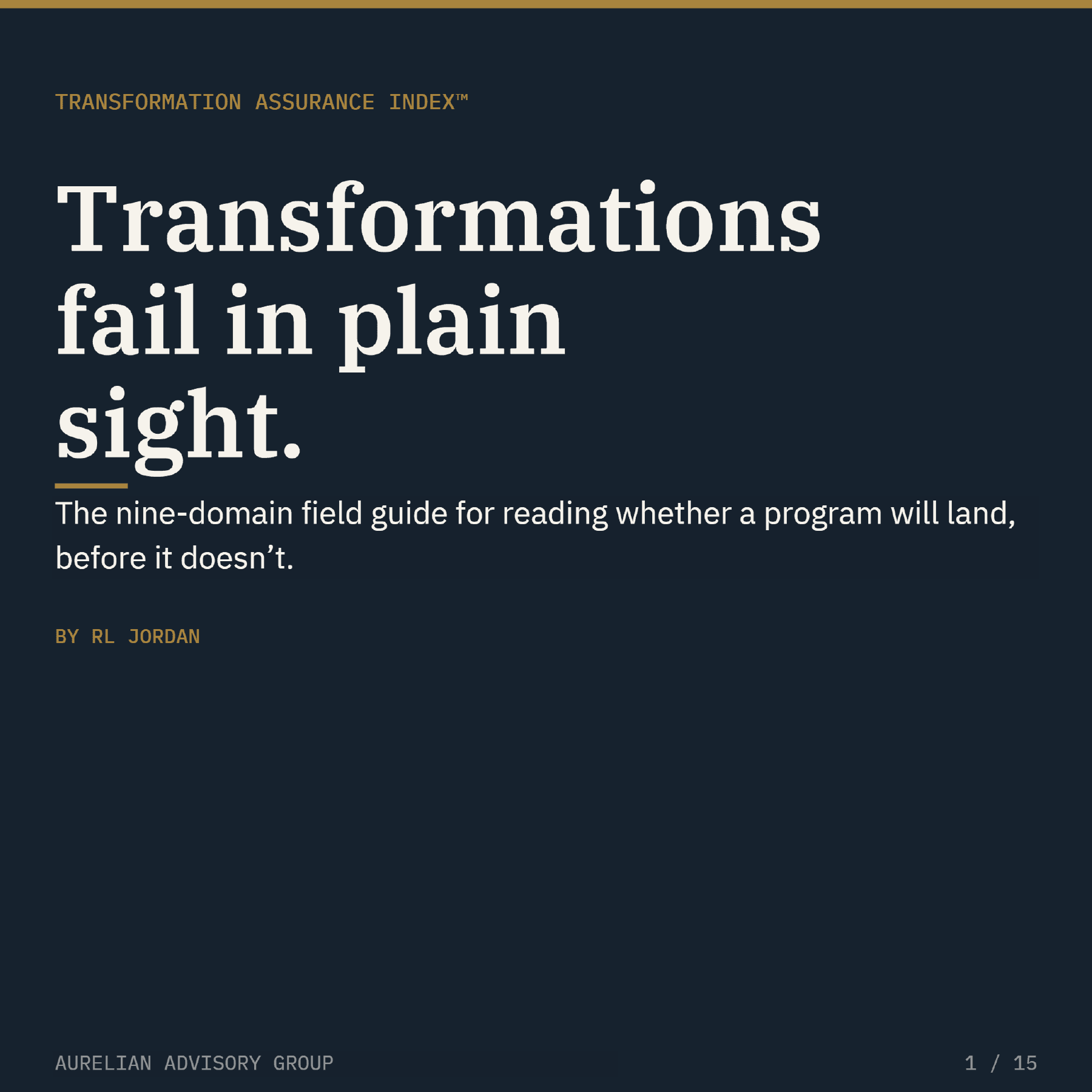
Transformations fail in plain sight.

A nine-domain field guide for reading whether a program will land before it does not. Created by Ronald L. Jordan Jr. to make an independent, evidence-based read of transformation health repeatable.

Cover of the Transformation Assurance Index by Ronald L. Jordan Jr.

The structural blind spot

The inside view gets greener at every layer.

Problems that sink a program are often visible for months: reconciliations nobody ran, designs still churning, and defect backlogs aging while the schedule keeps promising green.

Status rolls uphill and becomes more comfortable at every layer. A qualified amber at the workstream can become “on track” by the time it reaches the board.

The remedy is not more status meetings. It is a different vantage point.

The framework

Nine domains. One clear picture.

Each domain is a place programs reliably fail. Each has a tell: observable evidence that cuts through the reported status.

Governance & Sponsorship

01

Is there a single executive who owns the outcome, with authority over scope, budget, and go-live?

The tell

Watch how quickly cross-functional decisions get resolved. Strong governance clears them in days; weak governance lets them stall the work for weeks.

Scope & Requirements

02

Is scope baselined and under real change control, or are small changes being absorbed until the plan no longer matches reality?

The tell

Every requirement should trace to a design and a test. When it cannot, the gap will return as rework.

Program & Plan Health

03

Is there a genuine, dependency-linked critical path, or a list of milestones dressed up as a plan?

The tell

Ask the program to name its critical path. If it cannot, the schedule is decoration and green status is opinion.

Solution & Design Readiness

04

Are design decisions stable and signed off by the business, or still churning while the build races ahead?

The tell

Confirm that the integration architecture has been tested at real volume. Everything else is a design on paper.

Data Readiness

05

Has a full-volume mock conversion been run, reconciled to source, and signed off by named data owners?

The tell

If full-volume mock conversions have not been run and reconciled, you do not yet know whether the data is clean.

Testing & Quality

06

Are critical defects trending down with controlled aging, and are stage-gate exit criteria actually enforced?

The tell

A program that has never failed a gate is not disciplined. Watch the defect curve and who controls the exit criteria.

Change, Adoption & Readiness

07

Is readiness measured by role and the ability to perform on day one, or is training delivered being reported as readiness?

The tell

Determine whether super-users and process owners are confident, not merely trained. Those are not the same thing.

Cutover & Go-Live Readiness

08

Has cutover been rehearsed end to end, with timings, a real go/no-go, and an empowered rollback decision point?

The tell

Confirm that hypercare is staffed and scoped beyond the first few days. A support model that disappears after week one guarantees a crisis in week two.

Vendor / SI Performance

09

Does the system integrator's reported status hold up against independent evidence, and has key staffing remained stable?

The tell

Measure the gap between what the SI says and what the artifacts show. That gap is where real program health lives.

The scale

A shared language for “how ready is ready.”

The scale forces specificity that comfortable language avoids and makes evidence comparable across all nine domains.

  1. 1Absent / Ad hocNo defined approach; outcomes depend on individuals.
  2. 2Emerging / InconsistentSome pieces exist, applied unevenly.
  3. 3Defined / FunctionalDocumented and operating; a workable baseline.
  4. 4Managed / ProactiveMeasured and controlled; risks anticipated.
  5. 5Optimized / AssuredContinuously improved and resilient.

The rule scorecards get wrong

You cannot average your way to the truth.

Transformations do not fail on averages. They fail on their single weakest link. A program can be strong in seven domains and still be doomed by one. A blended score smooths exactly the gap that will sink the program and hands everyone a comfortable number that hides the one thing that matters.

Do not ask what the average says. Ask where the one red is, and whether anyone has the runway to turn it green.

Original field guide

Read the complete Index.

Download PDF

Your browser cannot display the PDF inline.

Open the Transformation Assurance Index

A useful first conversation

What becomes possible with a strategic perspective?

Bring the question that matters most. We’ll explore the situation, the stakes, and whether working together is the right next move.

Book a consultation